Getting Started
Welcome to the Spectra Protocol Documentation!
Spectra is building the DeFi interest rates derivatives layer.
From speculating on the evolution of DeFi interest rates, hedging risk on passive revenue, or providing liquidity to the derivatives layer, Spectra enables a whole new host of applications and use cases in the DeFi ecosystem.
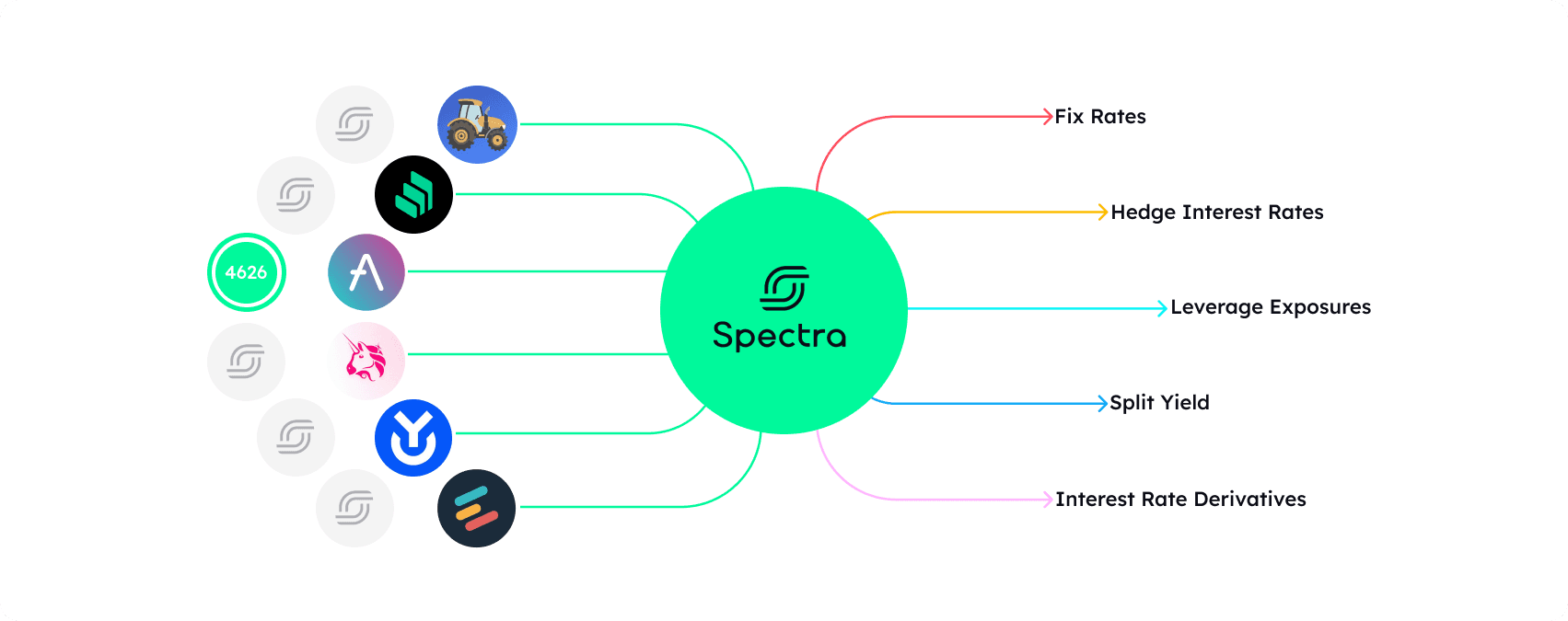
The basic building block in Spectra is yield tokenisation. What this means is that the yield generated on an asset can be separated from the underlying asset.
For example, Alice deposits 100 USDC into Aave, generating a yield of 3% after 1 year (3 USDC), meaning at the end of 1 year they are able to withdraw 103 USDC. However instead of waiting 1 year to get access to the yield, Alice could instead use Spectra to tokenise the yield, enabling them to withdraw close to the 3% yield (3 USDC) without having to wait 1 year (known as maturity). Alice is able to walk away with ~100 USDC (the principal) along with the yield that has been tokenised.
On the other end, Bob is confident that USDC yield will only increase over the next year, so they want to speculate by buying Alice's yield, which can be purchased for close to the value of 3% yield after 1 year (~3 USDC). Bob spends ~3 USDC and after 1 year, is able to access the yield generated, even if it results in more than 3 USDC (due to increased yield over the year).
The above is a straight forward, basic example of what is possible. There are many other possibilities for different types of users, providing liquidity, splitting yield over periods, etc, which will be explained in the following pages.